Natural herbs

Sunday, December 16, 2018

Procedure for entry and exit in Manufacturing Area


Procedure
Entry in Manufacturing Area-I
Open the door of air lock of manufacturing area-I and enter into the air lock.
Take an apron from SS cabinet and wear it.
Ensure the nose mask & cap is wore.
Wear the hand gloves.
Disinfect hands with 70% IPA.
Open the door and enter in to manufacturing area-I.

Exit from Manufacturing Area-I.
Open the door and enter into the air lock.
Remove the apron and keep it in the “Used linen Bin”.
Open the door and exit from manufacturing area-I.

Procedure for entry & exit   in sterile area sterile area.


Precautions :

Among all the persons duly entered in sterile area, only
those whose names are laid down in the list are applicable for
this procedure.  Others are not permitted strictly.

Ensure about the overall cleanliness of change room.
Aware about the personal hygiene during all activities.
Do not touch any surfaces with hands.  Try to use elbow for pushing
the door during entry.
Do not make rapid movement.
Enter in to next change room only when the door of first one is closed.
Gowning procedure is strictly followed as per laid down sequence.
Try to Keep yourself inside the sterile area for half session of the work.
Avoid talking, if required use gestures preferably.

Entry Procedure :

Airlock – I
Open the door of Airlock – I and enter in to the Airlock – I
Take out your footwear meant for manufacturing premises and keep them on
the rack provided therein .
Remove the factory garments and keep it in the cupboard.
Push the doors slowly and take entry in air lock –II.

Airlock – II
Disinfect your hands with filtered 70% IPA.
Pick up a set of sterilized garments from cupboard having
Do the gowning strictly as per laid down sequence as mentioned below. While gowning the sterile dress should not touch to the floor.
Headgear      
Boiler suit (single piece)
Booties
footwear
Look at mirror for tidiness and neatness and then only enter in third air lock
by opening the door gently with the help of elbow. 

Airlock – III
In third air lock, disinfect your hands with filtered 70% IPA.
Pick up a set of sterile hand gloves and wear it properly.
Disinfect the hands again with filtered 70% IPA. Allow to dry.
Enter in sterile corridor by pushing the door with elbow.
Disburse according to your work allotment in sterile area of manufacturing premises.
Exit Procedure: 
Airlock – IV
   After completion of the job, open the door of fourth air lock and enter in           
Airlock – IV.

    Remove the used sterile garments as laid down sequence.
Hand gloves
Foot wear
Booties
Boiler suit
Head gear
and put them in the bag and discard the set of dress in the “Used Linen           
Bin” provided in fourth air lock.
 Open the door of 1St air lock and enter in it.  Put on the factory garments and foot wears.
Open the door of corridor and come out in non sterile corridor.


 Procedure for performing Bubble point test.


Procedure
Precautions And Instructions:
Bubble point testing of membrane filter assembly should be performed before and after aseptic filtration of the solution by manufacturing chemist, and record there of should be maintained in the B.M.R.

Requirements:
                              Bubble point test assembly.

Procedures:
Remove the sterilized membrane filter assembly in sterile area.

Attach sterile silicon tubing at both ends.
Fill 2 liters sterile water for injection in bubble point test apparatus.

Attach upper end of silicon tube to the bubble point test apparatus and lower end to another sterile glass flask.

Filter 2 liters of sterile distilled water through membrane using Nitrogen pressure.
Remove the upper silicon tube and attach Nitrogen tube to the upper end of membrane holder.

Gradually increase the Nitrogen pressure up to 25 PSI  (1.5 lbs) and check for 30 seconds.
No bubble should come out from lower end of lower tube (which is dipped in the sterile distilled water) and there should be no fall in pressure, 


Tuesday, September 4, 2018

CONCEPTS AND PRINCIPLES OF HOMEOPATHY

CONCEPTS AND PRINCIPLES OF HOMEOPATHY


        Hippocrates (460 BC -370 BC), the father of medicine, had insisted that the physician has to study the patient, not just illness. In treating patients, he should do everything to assist the nature, the great healer, to affect cure. He advocated similimum. Rig Veda, the source book from which ayurveda originated, states that ‘a cure for poison lies in the poison itself’.

Monday, August 6, 2018

Antitussives (Latin Tussis- cough) are the agents which act upon the pulmonary membrane that hasten or alter expectoration. These stimulate and expel the bronchial mucous or secretions and help in their removal.


Sunday, August 5, 2018

ANTI TUMOR DRUGS

Antitumour (Latin : Tumor swelling, neoplasm) drugs are used in the treatment of cancer. The cancer or carcinogenic growth is an abnormal mass of new tissue growing in or on part of the body. Several types of carcinogenic growths have been reported. The cancer is regarded to be an incurable disease in secondary stages. The radioactive substances, metal compounds and several chemotherapeutic drugs have been suggested to control the carcinogenic growths.

The promising natural antitumour drugs or their isolates are obtained from the following:

Vinca : (Catharanthus roseus) Podophyllum : (Podophyllum hexandrum)
Colchicum : (Colchicum Iuteum) Benafsha : (Viola odorata)
Anacardium : (Semecarpus anacardium)

VlNCA
Synonyms : Catharanthus, Vinca rosea, Periwinkle

Biological Source: It is the dried whole plant of Catharanthus roseus 'G. Don., (syn vinca-roseai (Family : Apocynaceae).

Geographical Distribution:
It is probably indigenous to Madagascar. It is cultivated in South Africa, West indies, lndia, U.S.A., Europe and Australia as an ornamental plant, as well as, for its medicinal properties.

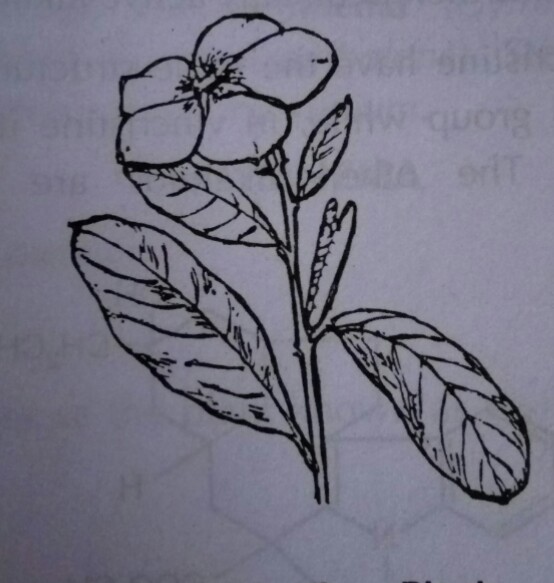
Organoleptic Characters (Fig) :
The leaves are green, roots are pale grey, flowers are violet, pink-white or carmine-red in colour. The odour is characteristic and taste is bitter. Vinca is an erect, pubescent herb, with branched tap-root. Leaves are simple, petiolate, ovate, or oblong, unicostate, reticulate, entire, brittle with acute apex and glossy appearance. Flowers are bractate,pedicellate, complete, hermaphrodite, normally 2 to 3 in cymose axillary clusters. Fruits are follicles with several black seeds.
VINCA ROSEA, VINCA FLOWERS
VINCA ROSEA

VINCA ROSEA,VINCA FLOWER
VINCA FLOWER


Chemical Constituents :
Vinca contains wide varieties of chemicals including the glycosides and alkaloids. The indole~indoline alkaloids are very important constituents. About 60 alkaloids have been isolated so far from different parts of vinca. The important alkaloids with anticancer property are vincristine and vinblastine. Vincristine is obtained in about 0.0002 % yield from the crude drug. The other alkaloids present in the drug are ajmalicine, serpentine, lochnerine and tetrahydroalstonine. The total alkaloidal content of the drug is about 1 %, of which only a fraction contains therapeutically active alkaloids.

Both vinblastine and vincristine have the same structures with the difference that in vinblastine there is N-methyl group while, in vincristine it is N-formyl group and both Possess different activities. The other alkaloids are vindoline, vindolinine and catharanthine.

Uses:
Vincristine is used in treatment of leukaemia. Vinblastine is used for the treatment of generalised Hodgkin's disease and chorionepithelioma. Vinca also exhibits hypotensive and antidiabetic activity.

Saturday, August 4, 2018

GINGER

Synonyms : Zingiber; Zingiberis, Sonth ,

Biological Source :
Ginger consists of rhizomes of Zingiber officinale Roscoe, Family : Zingiberaceae, scrapped to remove outer skin and dried in sun. It contains not less than 0.8% of total gingerols on dried basis.

Geographical Distribution :
it is said to be native of South East Asia, but is cultivated in West Indies, Africa, Australia, Mauritius, Jamaica, Taiwan and India. More than 50 % of the world's
production is from lndia.

Organoleptic Characters
Colour : Externally, it is buff coloured,

Odour : Aggreeable and aromatic.

Taste : Aggreeable and pungent. Size : Rhizomes of ginger are about 5 to 15 x 1.5 to 6.5 cm.

Shape : Rhizomes are laterally compressed bearing short flat, ovate and oblique branches on the upper side, with bud at the apex.
T.S OF GINGER,GINGER
T.S OF GINGER


ZINGER OFFICINALE, GINGER
ZINGER OFFICINALE


Fracture '. Short and fibrous.
 Uses :
Ginger is used as a stomachic, an aromatic, a carminative, stimulant and flavouring agent. Ginger oil is used in mouth washes, ginger-beverages and liquors.

ADS

Blogroll

Ads

BTemplates.com

Powered by Blogger.

Featured Post

PERFUMES AND FLAVOURS

A. PERFUMES : it is any substance which is made from natural or synthetic materials, or a combination of both, employed for creating a ...

Popular Posts